Context
Large organizations accumulate massive amounts of data across diverse databases, cloud storage, and APIs. Navigating and fetching this information for analytics, compliance, or runtime decisions is extremely difficult due to differing query languages and permission structures. To solve this, the Veritas Information Fabric was engineered as a technology platform designed to aggregate, index, and analyze metadata across an organization’s global, unstructured data environment. By utilizing Veritas NetBackup as a proxy, it continuously surfaces a unified, searchable view of data without needing to continuously scan petabytes of primary storage.
Problem
Data scientists and application developers spent excessive time writing custom extraction scripts and API adapters. This resulted in fragile data pipelines, security bottlenecks, and massive data duplication. The engineering challenge lay in handling tens or hundreds of billions of metadata objects while returning interactive queries in seconds. Furthermore, translating these complex, abstract big-data frameworks and cloud-native architectures into an intuitive visual interface was a major bottleneck, slowing down a user’s ability to identify orphaned files, stale data, and hybrid-cloud compliance risks.
Impact
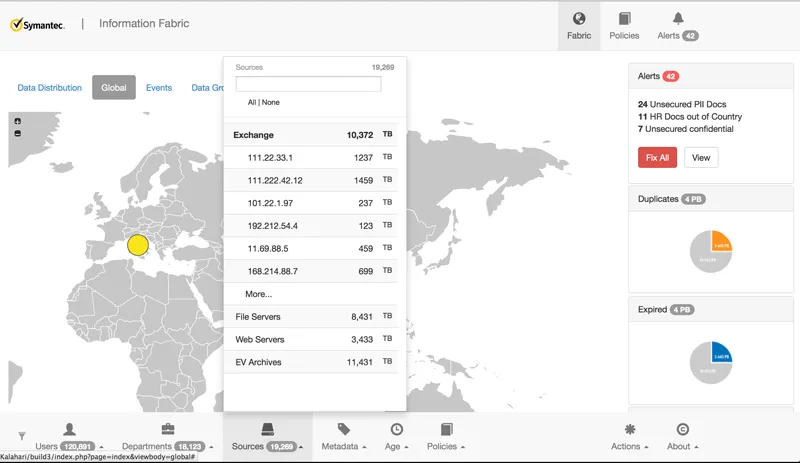
Designed the core user interface for the Information Fabric layer and its primary cloud-based dashboard application, the Veritas Information Map. Operating as a design engineer, I personally built a fully functional end-to-end prototype of the platform’s visual interface using PHP, HTML, CSS, JS, Bootstrap, and MySQL. This prototype bridged the gap between back-end big data collectors and user experience, serving as the production blueprint for the engineering team.
By delivering this unified interface and architecture, we:
- Solved the data access bottleneck by translating complex metadata infrastructure into an interactive visual dashboard.
- Enabled unified visibility and reporting across complex hybrid and multi-cloud environments via NetBackup IT Analytics integration.
- Reduced storage costs and mitigated compliance risks for enterprise clients by allowing them to instantly identify orphaned, stale, or high-risk data assets.